Understanding U.S. Amateur Radio
A Market Research Proposal for ARDC
Jim Idelson · K1IR
August 2026
1. The Assignment
ARDC wants better data about U.S. amateur radio operators: who they are, where they get information about technical topics, and what got them involved in amateur radio.
The research is focused on three key questions:
- Who are U.S. amateur radio operators?
- Where do they get information about technical topics?
- What got them involved in amateur radio?
The purpose is practical: give ARDC stronger evidence for outreach, grantmaking, assessment of grantee plans and outcomes, efforts to broaden participation, and future measurement.
This first study will focus on U.S. amateur radio operators. The narrower scope takes advantage of the FCC licensing database and establishes a strong research foundation that can be extended and repeated in future studies.
2. Proposed Approach
Start with what is already knowable, and survey for what is not.
The research will begin with the FCC Universal Licensing System (ULS), add useful information from appropriate external sources, and use a representative survey to collect the personal characteristics, experiences, behaviors, and attitudes that existing data cannot reliably provide.
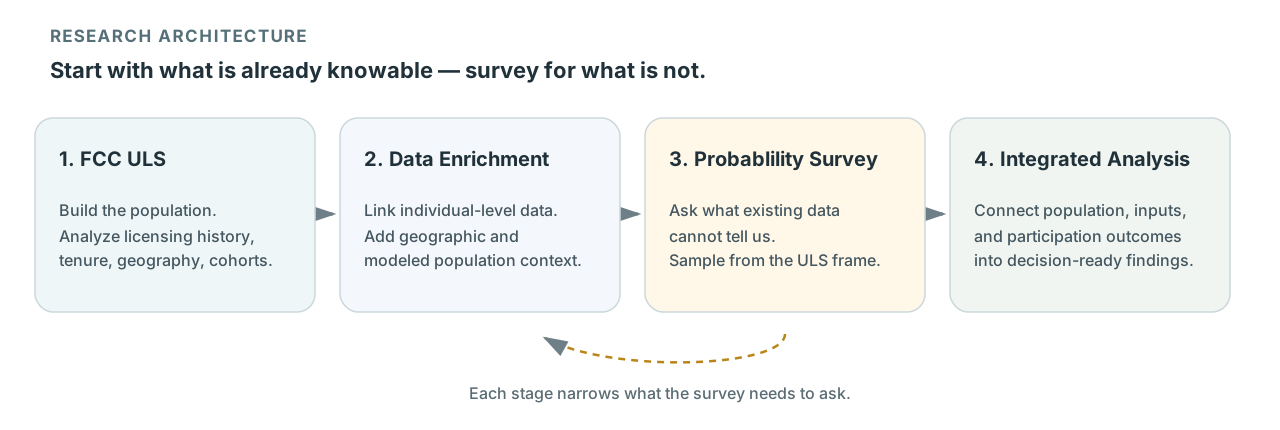
FCC ULS → Data Enrichment → Representative Survey → Integrated Analysis
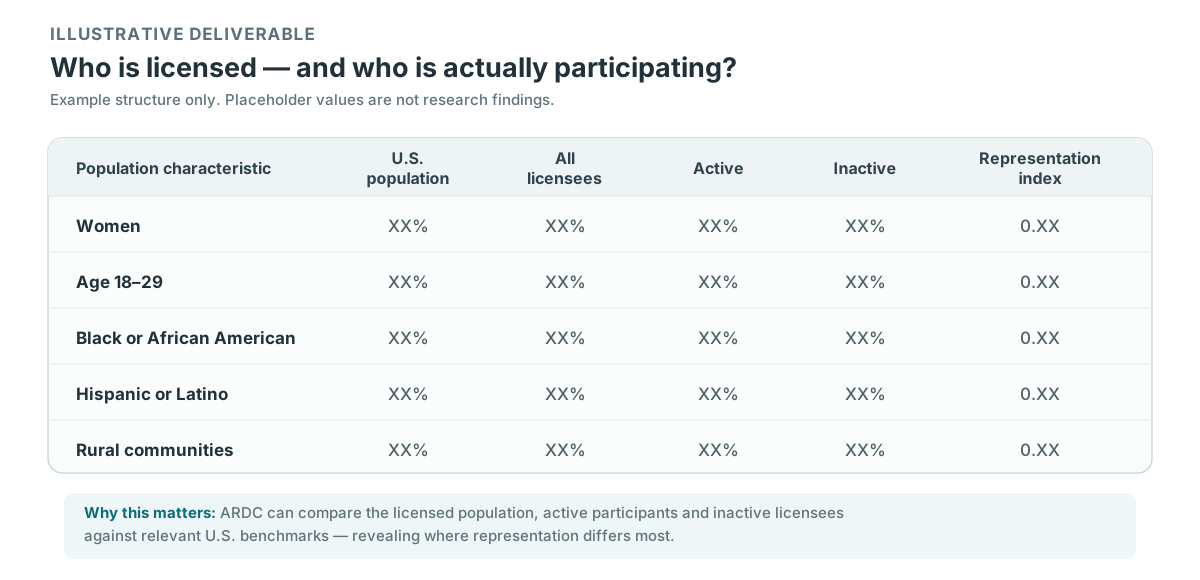
Because the FCC licensee population includes people who are no longer meaningfully active, we propose distinguishing Active from Inactive licensees. This allows us to separate the profile of the licensed population from the profile of people who are actually participating — an important distinction if ARDC wants its outreach and grantmaking decisions to focus on the active amateur-radio community.
The result will be a statistically defensible picture of the U.S. amateur-radio licensee population — who is active, who is not, and how those populations differ — that answers ARDC's immediate questions while establishing repeatable benchmarks for measuring change over time.
The proposal uses three scope levels. Baseline provides a complete, rigorous answer to the assignment as posed. Recommended adds the dimensions expected to produce the greatest increase in decision value. Extended develops more of the research asset's potential through deeper segmentation, enrichment, subgroup resolution, and specialized analysis.
This structure provides flexibility in project scope without compromising the quality of the core research.
3. What ARDC Will Receive
3.1 Executive Findings, Recommendations, and Briefings
A concise synthesis of the most important findings across the research and their implications for ARDC.
The executive findings will highlight:
- major population and demographic findings;
- important differences between Active and Inactive licensees;
- opportunities to improve outreach;
- implications for grantmaking and grantee outreach plans;
- findings relevant to underserved or underrepresented populations; and
- priorities for future research and measurement.
The research will be translated into clear, plain-language findings that can be used without substantial interpretation or rewriting.
Internal briefings will be prepared for ARDC staff and the Board, with appropriate presentations or discussions for groups whose work can directly benefit from the findings, including the Grants Advisory Committee, Grants Evaluation Team, and 44Net team.
Following internal review, the findings will be adapted for broader publication and use by grantees, amateur-radio clubs, organizations, and the industry.
The goal is not simply to report what the data says, but to make clear what ARDC and others can do with what has been learned.
3.2 Three Research Reports
The core research will produce three reports corresponding directly to ARDC's three questions. Each begins with a rigorous Baseline; the Recommended and Extended levels add depth where additional enrichment, survey content, sampling, or analysis is most valuable.
3.2.1 U.S. Amateur Radio Population Profile
Answers: Who are U.S. amateur radio operators?
Baseline
The Baseline will provide a statistically representative profile of the U.S. amateur-radio licensee population using FCC ULS data, selected external enrichment, and the core survey.
It will characterize the population across the most important demographic, geographic, licensing, and participation dimensions and compare relevant findings with U.S. population benchmarks.
ULS licensing history will also allow useful comparisons by license tenure, including recent licensees whose entry experiences are still relatively fresh.
Recommended
The Recommended level adds the especially important distinction between Active and Inactive licensees and a richer participation profile. It can also expand the population profile where additional investment is most useful. Potential additions include:
- additional individual, household, geographic, or probabilistic enrichment;
- additional demographic and socioeconomic characteristics;
- targeted oversampling of priority or low-incidence populations; and
- richer measures of participation type, intensity, and engagement.
These participation profiles can be linked to information sources and entry pathways, helping identify which influences are associated with stronger, weaker, or different participation outcomes. Extended scope can add still deeper subgroup analysis, enrichment, and oversampling.
Value to ARDC: establish population benchmarks, identify underserved or underrepresented groups, distinguish licensing from meaningful participation, and identify populations deserving particular attention or investment.
3.2.2 Technical Information Ecosystem
Answers: Where do amateur radio operators get information about technical topics?
Baseline
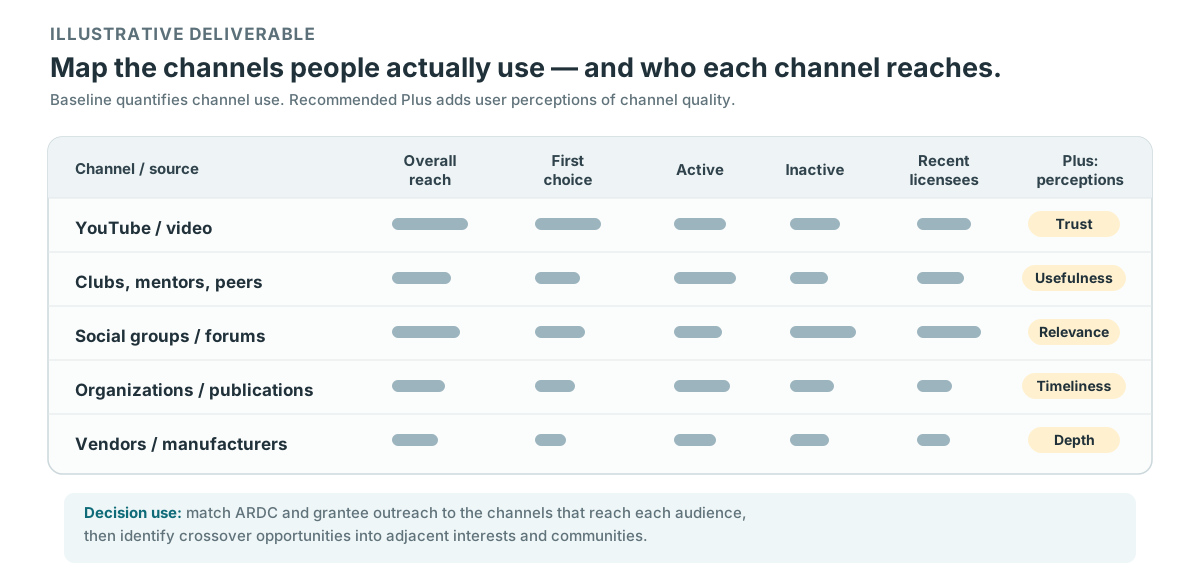
The Baseline will identify and quantify the information channels amateur radio operators use for technical information.
The research will organize sources into useful channel categories while also identifying important individual sources within those categories. Survey design will allow respondents to identify sources outside the categories or examples we provide, rather than forcing their answers into a predefined taxonomy.
It will examine:
- source usage and frequency;
- first-choice sources for different needs;
- important podcasters, YouTube channels, newsletters, publications, groups, and other sources;
- differences among demographic, licensing, and participation groups; and
- audience crossover that may reveal opportunities to reach people through adjacent interests or communities.
The result will be a quantitative map of the technical-information landscape showing where different parts of the amateur-radio population actually go for information.
Recommended
The Recommended level adds measurement of how users experience and evaluate those channels.
Additional survey measures may examine characteristics such as:
- trust;
- usefulness;
- timeliness;
- accessibility;
- relevance;
- depth; and
- ability to address an individual's specific question.
This adds an important layer to the usage data: not only which channels have reach, but which are perceived as serving particular audiences especially well or poorly.
Value to ARDC: improve outreach, assess grantee communications plans, identify effective channels for particular audiences, discover new audience crossover opportunities, and identify populations whose technical-information needs may be poorly served.
3.2.3 Pathways into Amateur Radio
Answers: What got people involved in amateur radio?
Baseline
The Baseline will characterize three distinct parts of the entry experience:
- Initial exposure: How did people first encounter amateur radio, and who or what introduced them?
- Motivation: What interests, needs, experiences, or social factors made amateur radio worth pursuing?
- Learning and licensing: What path did they follow from interest through learning, preparation, examination, and licensing?
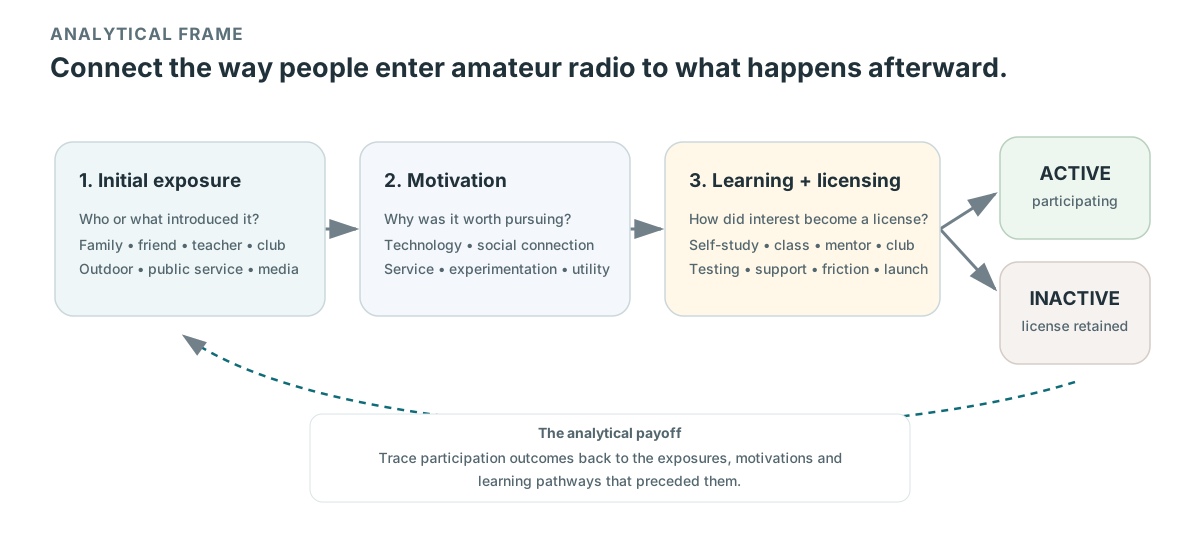
The analysis will identify the principal people, organizations, activities, interests, motivations, and learning resources involved and examine how pathways differ among important population groups.
The Baseline identifies and quantifies the principal exposure, motivation, and learning and licensing pathways.
Recommended
The Recommended level links pathways to participation outcomes and investigates why some pathways appear to lead to durable participation while others do not. This makes it possible to compare Active and Inactive licensees and identify entry experiences associated with different subsequent outcomes.
Additional survey and analytical work may examine:
- quality and continuity of mentoring or support;
- friction during learning and licensing;
- expectations before licensing versus experience afterward;
- access to equipment, stations, activities, and communities;
- the success or failure of the post-license launch; and
- early experiences associated with continued participation or disengagement.
Where especially important findings emerge, selected qualitative interviews could provide additional depth.
The objective is to identify recurring success patterns, failure patterns, and intervention points — distinguishing pathways worth reinforcing, pathways that may need additional support, and approaches unlikely to produce durable participation.
Value to ARDC: understand how people enter amateur radio, distinguish licensing success from lasting participation, identify where promising pathways break down, and target investments toward approaches most likely to produce durable involvement.
3.3 Participation and Engagement Profile
At the Recommended level, participation and engagement serve as a cross-cutting analytical dimension for all three research questions.
Recommended includes a consistent Active/Inactive classification and a useful profile of how deeply and in what ways people participate — for example through operating, technical learning and experimentation, public service, education, outdoor activity, competition, community involvement, and other forms of engagement. Extended can add more advanced participation and engagement modeling.
This framework can also identify strategically important participation segments, including Active licensees who pursue technical learning and experimentation.
These measures and segments can then be linked back to demographic characteristics, information channels, and entry pathways, allowing the research to examine which influences are associated with different participation outcomes.
3.4 Research Data and Reuse Package
The project will create a documented research foundation that supports both the current analysis and future measurement.
Protected analytical data may include identifiable survey, linkage, and enriched individual-level records required to conduct the research. These will be handled under appropriate privacy and security controls.
Open research resources are expected to include, where feasible and appropriate:
- survey instruments;
- methodology and sampling documentation;
- weighting documentation;
- data definitions and documentation;
- important aggregate tables and derived measures;
- appropriately deidentified public-use data; and
- the principal reports and findings.
Core definitions and measures will be designed for repetition, establishing benchmarks that can support future trend, cohort, and longitudinal research.
Software, scripts, analytical tools, and reusable technical infrastructure used to perform the work are not project deliverables.
4. How the Research Will Be Built
4.1 Start With the Population: FCC ULS
The FCC Universal Licensing System provides an unusually strong starting point for this research.
Rather than begin with a survey and attempt to infer the population from those who respond, the project can begin with the known population of U.S. amateur licensees.
I have worked with FCC ULS data for a number of years and have developed tools and experience for exploring its structure and history. That existing familiarity provides a head start in turning the administrative data into a useful research population.
ULS analysis can provide or support information such as:
- current license status and class;
- initial licensing and license tenure;
- upgrade history;
- renewal and expiration history;
- geography and movement over time; and
- other licensing patterns that prove useful during analysis.
The historical record also makes it possible to define useful cohorts — for example, very recent licensees, operators licensed several years ago, and long-tenured operators — and compare how answers differ by stage of the licensing journey.
The guiding principle is simple:
Do not ask survey respondents for information that can already be obtained reliably from existing data.
This reduces respondent burden and preserves survey space for the questions only people themselves can answer.
4.2 Enrich the Population
ULS provides the population frame, but it is not the only useful source of information.
The project will evaluate external data sources that can responsibly extend the population profile. These may contribute either additional information linked to individual licensees or contextual and modeled information that helps characterize populations and subsegments.
Potential sources include:
- Census and other geographic data;
- public amateur-radio activity sources;
- selected individual- or household-level enrichment data;
- research partnerships with amateur-radio organizations or businesses;
- aggregate industry data;
- other relevant behavioral or participation data; and
- additional sources identified during the research.
Where reliable individual-level information is available, it can be linked to the ULS population. Where it is not, geographic and other external data can support statistically modeled estimates of population and segment characteristics.
The analysis will maintain a clear distinction between characteristics that are known, self-reported, contextual, or statistically estimated. Estimated characteristics will be used at a level appropriate to their accuracy and uncertainty.
A key methodological principle will be maintained throughout:
ULS defines the licensed population. External sources provide additional views of it.
An external activity database, membership list, customer database, or online community is inherently selective and will not be treated as a substitute for the underlying population frame.
4.3 Ask People What Existing Data Cannot Tell Us
A representative survey will collect the information that administrative and external data cannot reliably provide.
The final questionnaire will be developed during the research-design phase, but major areas are expected to include:
- personal demographic characteristics;
- Active or Inactive status and participation;
- technical-information sources and habits;
- initial exposure to amateur radio;
- motivations for pursuing it;
- people and organizations that influenced entry;
- learning and licensing paths;
- household and family influences; and
- early post-license experiences where included in the selected scope.
Questionnaire development will distinguish carefully among exposure, motivation, and pathway rather than forcing these different ideas into a single answer structure.
Questions and response categories will be informed by domain knowledge but tested in ways that allow the actual structure to emerge from the research rather than assuming it in advance.
4.4 Make the Findings Representative
The value of the research depends on understanding the population accurately, not simply collecting a large number of responses.
The project will therefore use a probability-based sample drawn from the FCC population wherever practical, with deliberate design choices to ensure that important populations can be analyzed.
The fielding plan will use a mixed-mode approach where appropriate, so sampled licensees are not dependent on a single response method. A likely design would combine postal recruitment with web response, supplemented where useful by paper questionnaires and targeted telephone follow-up. This is especially important in a population that includes substantial numbers of older licensees and people with differing levels of comfort or access to online survey tools.
The research design will address:
- probability sampling;
- sample size and precision;
- mixed-mode recruitment and response;
- deliberate oversampling of important or low-incidence populations where warranted;
- adequate representation of Inactive licensees;
- representation of recent licensees and other useful tenure cohorts;
- inclusion of younger operators and other priority populations;
- questionnaire testing and pilot fielding;
- response-rate monitoring;
- nonresponse analysis;
- statistical weighting and calibration;
- bias assessment; and
- independent statistical or methodological review where valuable.
For licensees who are minors, the fielding plan will specifically address appropriate consent, privacy, contact, and data-handling requirements before outreach begins.
The sample and fielding design will be built around the decisions ARDC wants the research to support rather than around an arbitrary target number of responses.
Detailed treatment of sampling, statistical confidence, bias management, and privacy is provided in the supporting appendices.
4.5 Integrate and Analyze
The final analysis will bring the different evidence sources together rather than treating them as unrelated research products.
ULS + External Data + Survey Results → Integrated Analytical Dataset
The analysis will support:
- population and demographic profiling;
- Active versus Inactive comparisons;
- recent-licensee and license-tenure cohort analysis;
- comparison with relevant U.S. population benchmarks;
- analysis of technical-information sources and audience crossover;
- analysis of exposure, motivation, and learning/licensing pathways;
- participation and engagement analysis at the selected scope;
- comparisons among important population groups;
- identification of underserved or underrepresented populations; and
- establishment of repeatable research benchmarks.
The objective throughout will be to distinguish findings that are strongly supported by the data from findings that are exploratory, suggestive, or deserving of future research.
5. Project Plan, Schedule, and Budget
5.1 Project Plan
The project plan follows the same sequence as the research approach:
FCC ULS → Data Enrichment → Representative Survey → Integrated Analysis
Importantly, analysis begins before the survey is designed. Each stage informs the next, allowing the survey to concentrate on questions that existing data cannot answer and helping determine which populations require particular attention in the sample.
Phase 1 — Build and Analyze the FCC Population
The project will first develop the ULS research population and conduct an initial analysis using FCC data alone.
This work will:
- construct and validate the population and relevant licensing history;
- establish basic demographic, geographic, license-class, and tenure profiles available from ULS;
- identify recent-licensee and other useful cohorts;
- examine licensing, renewal, expiration, upgrade, and geographic patterns;
- identify questions that can be answered without surveying licensees; and
- establish the population frame from which the survey sample will ultimately be drawn.
This phase produces useful research findings in its own right while establishing the foundation for everything that follows.
Phase 2 — Enrich and Extend the Population Profile
Selected external sources will then be added to the ULS population where they provide useful and responsible additional information.
This phase will:
- add appropriate Census and geographic characteristics;
- evaluate selected individual-level, contextual, behavioral, or probabilistic enrichment sources;
- assess the coverage and limitations of each source;
- identify population characteristics and segments that may require special survey attention; and
- refine the questions and hypotheses that the survey needs to address.
The result will be an enriched research population and a much clearer understanding of what is already knowable and what must still be asked directly.
Phase 3 — Design the Survey and Select the Sample
Only after the ULS and enrichment work is substantially complete will the survey design be finalized.
This phase will:
- define the remaining questions that only licensees themselves can answer;
- develop and test the questionnaire;
- select a probability-based sample from the ULS population;
- define stratification and any targeted oversampling;
- ensure appropriate representation of Inactive licensees, recent licensees, younger operators, and other priority populations;
- establish mixed-mode recruitment and response methods; and
- conduct pilot testing before full fielding.
Key survey and sampling choices will be reviewed with ARDC before the instrument is locked.
Phase 4 — Field the Survey and Build the Integrated Dataset
Following the pilot:
- launch and monitor the full survey;
- track response and representation of important groups;
- use appropriate reminders and mixed-mode follow-up;
- conduct nonresponse analysis;
- develop statistical weights and calibration; and
- link survey responses, under appropriate privacy controls, to the relevant ULS and enrichment data.
This creates the integrated analytical dataset:
ULS + Enrichment + Survey Responses → Integrated Research Dataset
Phase 5 — Integrated Analysis, Internal Review, and Publication
The final phase will use the combined evidence to answer ARDC's three research questions.
Work will include:
- integrated population and demographic analysis;
- Active and Inactive comparisons;
- analysis of technical-information channels;
- analysis of exposure, motivation, and entry pathways;
- participation and engagement analysis at the selected scope;
- development of the three research reports;
- executive findings and recommendations; and
- preparation of research data and documentation for reuse.
Principal findings will be prepared for internal ARDC review in March 2027, including staff, the Board, the Grants Advisory Committee, Grants Evaluation Team, 44Net team, and other appropriate groups.
Following internal review, the research will be finalized for broader publication, grantee and club use, outreach, and spring conference-season communications.
5.2 Target Schedule
The proposed schedule works backward from an important ARDC decision point: internal review of the findings in March 2027, in time to inform the Board's strategic-planning process.
Assuming a project start in September 2026:
| Period | Major Activity |
|---|---|
| September–October 2026 | Design and ULS population: complete research design, build and validate the ULS research population, reconstruct relevant licensing history, conduct initial ULS-only analysis, and identify useful cohorts |
| October–November 2026 | Enrichment and sample design: add and evaluate selected external data sources, extend the population profile, design the probability sample, and develop the questionnaire |
| November 2026–January 2027 | Pilot and fielding: test the questionnaire and fielding process, launch and monitor the probability survey, conduct reminders and follow-up, and assess response and representation |
| January–February 2027 | Integration and analysis: complete weighting and calibration, build the integrated dataset, analyze the combined evidence, develop the three research reports, and prepare executive findings |
| March 2027 | Internal review: present principal findings to ARDC staff, Board, and relevant committees and teams for strategic review and discussion |
| April–May 2027 | Publication and dissemination: incorporate internal feedback, finalize reports and research data resources, prepare public-facing materials, and support broader outreach and conference-season communications |
March Internal Review
The March milestone is intended to give ARDC time to consider the findings before broader publication.
The internal review can include:
- ARDC staff;
- Board of Directors;
- Grants Advisory Committee;
- Grants Evaluation Team;
- 44Net team; and
- other internal groups whose planning or decision-making can benefit from the findings.
Different groups may require different emphasis. Grantmaking teams, for example, may focus on population gaps, pathways, and outreach effectiveness; 44Net may find particular value in technical-information channels and the characteristics of technically engaged populations.
Following this review, the public-facing research can be finalized with the benefit of ARDC's internal interpretation and prepared for broader release during the spring conference and outreach season.
5.3 Budget and Scope Options
The Baseline / Recommended / Extended structure allows ARDC to vary the depth of the research while preserving a coherent core study.
The Baseline provides a complete, statistically rigorous answer to all three questions. Recommended adds the highest-value decision insight, while Extended develops more of the research asset's potential.
| Component | Baseline | Recommended | Extended |
|---|---|---|---|
| Population profile | Core demographic, geographic, licensing, and participation characteristics | Additional characteristics and deeper population segmentation | Broader profiling of priority and low-incidence populations |
| Data enrichment | ULS plus core geographic and Census enrichment | Selected individual-level and probabilistic enrichment | Broader enrichment from additional behavioral or external sources where feasible |
| Participation | Core licensing and population profile | Active/Inactive classification, technical/STEM-oriented segmentation, and participation depth and type | Advanced participation and engagement modeling |
| Information channels | Identify and quantify channels, sources, usage, and audience differences | Add user perceptions such as trust, usefulness, relevance, and timeliness | Deeper channel, audience, and crossover analysis where warranted |
| Entry pathways | Exposure, motivation, and learning/licensing paths | Link pathways to participation outcomes and add post-license experience, support, friction, and disengagement factors | Selected pathway deep dives and qualitative follow-up |
| Sampling | Representative probability sample with mixed-mode fielding and weighting | Targeted oversampling of selected priority populations | Larger or additional oversamples for finer subgroup analysis |
| Deliverables | Three reports, executive findings, research-ready data, and documentation | Core deliverables plus the selected Recommended analyses | Core deliverables with the fullest selected analytical depth |
| Approximate Price | ~$90,000 | ~$115,000 | Up to ~$150,000 |
The Recommended program, at approximately $115,000, is the proposed planning point and is consistent with ARDC's stated budget guidance.
Final allocation of Recommended or Extended resources can be determined with ARDC as the early ULS analysis and enrichment work clarifies where additional investment is most likely to produce value.
Research rigor, representative sampling, bias control, mixed-mode fielding, weighting, and responsible data stewardship are part of the Baseline and are not optional features.
6. Why Jim
This project benefits from a combination of research experience, data expertise, amateur-radio knowledge, and direct familiarity with FCC licensing data.
Market Research and Strategy
Extensive experience designing research programs and translating evidence into practical strategic and investment decisions.
Data and Longitudinal Research
Experience working with large customer and population datasets, segmentation, adoption research, and recurring benchmark programs designed to measure change over time.
FCC ULS Experience
Years of direct work with FCC ULS data, including exploration of its structure, licensing history, and analytical potential.
Amateur Radio Domain Knowledge
Deep familiarity with amateur radio across operating, technical, educational, organizational, and community dimensions.
That combination helps reduce an important risk in specialized research: producing statistically sound answers to questions that fail to capture how the domain actually works.
More detailed background is provided in:
- Appendix A — About Jim
- Appendix B — Selected Relevant Research Experience
Supporting Information
- Appendix A — About Jim
- Appendix B — Selected Relevant Research Experience
- Appendix C — Sampling, Response Rates, and Statistical Confidence
- Appendix D — Bias Control and Representativeness
- Appendix E — Privacy and Data Stewardship